
Introduction
Shoppers on Shopify love top search results, especially if they are useful and relevant to them. It is the icing on the cake if search results are AI-driven, as buyers are now upgrading themselves alongside the technology. More shoppers are exploring AI-powered search tools to discover products, compare options, and find recommendations based on their needs.
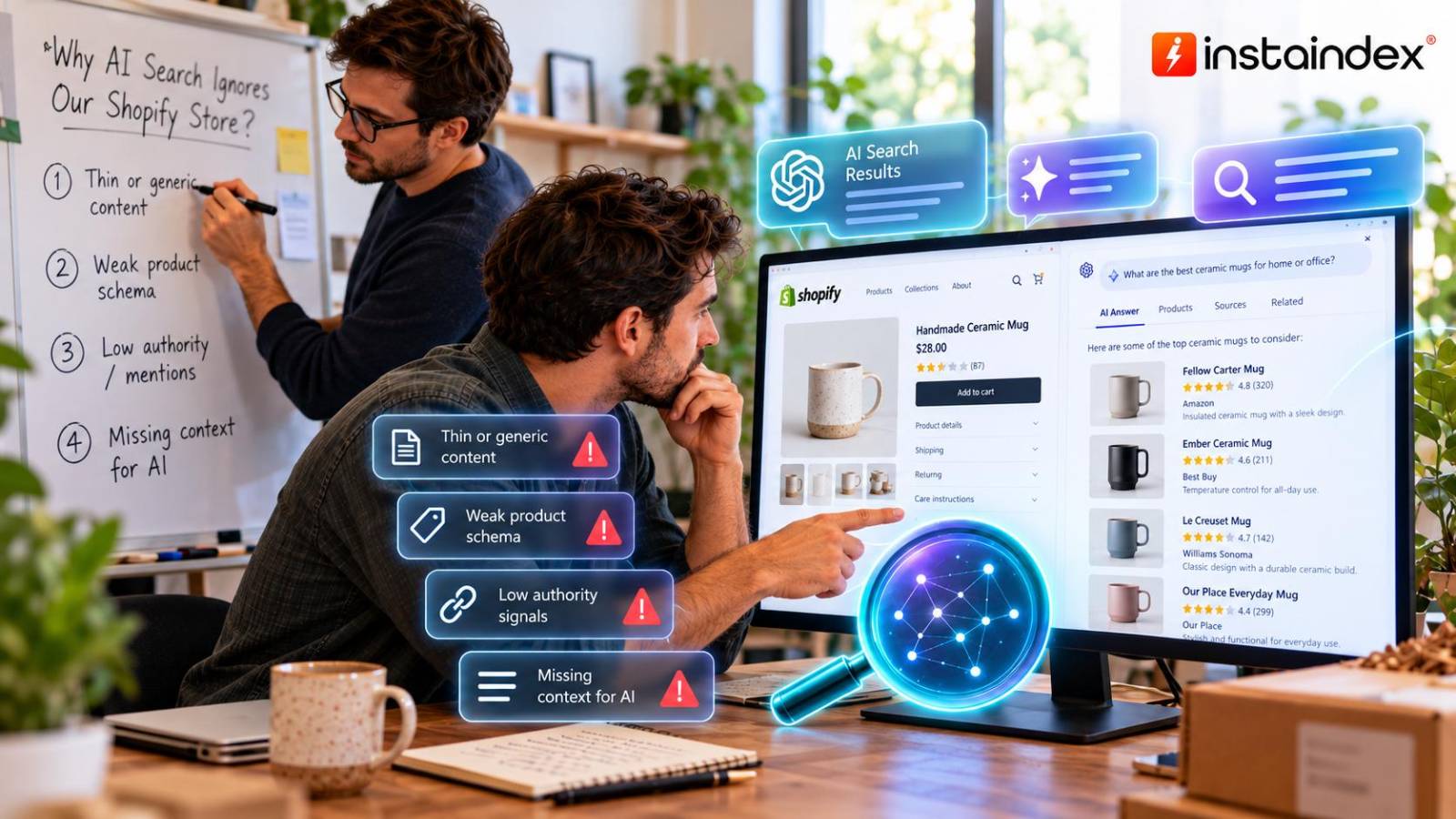
As a Shopify store owner, how would you feel if customers see your product in AI searches? Amazing right? But do you even know whether AI understands your store? Your Shopify store can look obvious or perfect to humans, but internally it may have several issues that stop AI platforms from understanding your store.
Whether you have great products, polished descriptions, well-structured pages, and engaging designs, it doesn’t mean AI will interpret your store easily and quickly. This makes AI visibility another crucial part of Shopify SEO.
In this article, we will explore the top hidden reasons Shopify AI search engines ignore your store. This helps you understand where you are lagging and what improvements you can make to your store for better AI visibility.
What Does AI Search Actually Look For in a Shopify Store?
In traditional search, users simply received a list of webpage links when searching for something, but the advent of AI has changed the way people search and find answers.
Unlike traditional search results that mainly display webpage links, AI-powered search can summarize information from different sources, answer detailed questions, and suggest relevant products based on what users are looking for.
That makes understanding your information especially important.
A normal human can see your store and understand every piece of information clearly, like:
- Price
- Product description
- Availability
- Features
- Functions
- And what exactly a product does
But AI platforms don’t work like this; they seek structured data, accurate content, technical signals, links, and other sources. It gives them a clear understanding of your store and recommends information to users if something feels relevant.
7 Reasons AI Search May Ignore Your Shopify Store

There could be several reasons why AI is overlooking your Shopify store. So now, to help you out. Here are the top 7 reasons, or you can say common reasons, giving you clarity on what your store is actually dealing with:
- AI Crawlers are Somehow Blocked
Before AI platforms understand your store pages, their crawlers visit the store. Basically, AI crawlers are automated systems that visit and read your pages. And your robots.txt file gives instructions to the crawlers about what areas or sections of the website they can access.
But sometimes, these crawlers may get blocked, which can make understanding the information in your store complicated. This doesn’t mean you have to allow every crawler to check information, but at least review your settings carefully to make sure you haven’t blocked the crawlers you want to access your store.
- Missing or Incorrect Schema Markup
Schema is structured information mentioned on your page, like your product description, price, availability, and more. This schema helps AI platforms to understand the store information clearly and in a structured way.
Without appropriate schema markup, search engines and other systems may have less structured information available about your products. Although they can still understand content without schema, accurate structured data helps provide clearer details about your products, such as their price, availability, and specifications.
- Your Product Information Sends Mixed Signals
This is one of the common Shopify AI search issues. One of your pages says the product costs $500 and is in stock, but on the other side, your structured data says the product costs $700, and it is currently out of stock. This confuses AI platforms and other search engines, leading to inaccurate information and problems in deciding on the right information.
- Product Details Don’t Give Enough Context
You have already written a product description, but it may not be enough for AI platforms, as they need proper and detailed information about the product. The description should be straightforward and give more context about the product.
When you give an accurate and detailed description of the product, it will help not only shoppers to make decisions, but also allow AI platforms to interpret the information.
- Still Older Version Being Seen
AI systems still see your older store data, whether you launch a new product, change prices, or upgrade inventory. This happens when AI systems don’t get updates whenever you make a change in your store. That’s why IndexNow is crucial for your overall Shopify store and especially for AI visibility.
IndexNow helps notify participating search engines and supported services when relevant URLs change. But it doesn’t mean your product pages will be indexed faster or rank faster; it still depends on your overall SEO.
- Your Brand Has Limited Online Presence Beyond Your Store
AI search platforms may use information from different sources, not just your Shopify website. If your brand has very few genuine customer reviews, mentions on relevant websites, or independent discussions about its products, AI systems may have less information available to understand your brand and assess its relevance.
For example, two stores may sell similar products, but one has genuine customer reviews, detailed buying guides, and mentions on trusted websites, while the other has information only on its own website.
This doesn’t guarantee the first store will appear in AI results, but a stronger online presence can provide additional context about your products and brand.
- Technical SEO Problems
Sometimes, the reason is not only the store itself, but there can also be a technical problem. Your store may have amazing content, top-notch products with well-structured data and descriptions, but it may be useless if AI systems and search engines don’t notice them. Because there can also be technical issues like:
- NoIndex tag
- Robots restrictions
- Incorrect canonical tags
- Broken URLs
- Incorrect redirects
How to Make Your Shopify Store More AI-Friendly
We have talked about all the hidden reasons; now let’s discuss how to prevent these issues:
- Accessibility
At first, make sure crawlers can reach every important page of your store.
Then, look for the technical blocks and remove the unnecessary ones:
- Robots.txt
- Noindex directives
- Canonical tags
- Broken pages
- Redirects
- Important product and collection URLs
- Make Information Easy to Understand
Instead of giving a fancy version of the product information, keep it natural, accurate, and consistent. Keep information in this way:
- Product name
- Description
- Price
- Availability
- Variants
- Specifications
- Reviews
And make it properly structured with schema, as AI systems won’t work like humans.
- Keep Schema Accurate
Your main task isn’t just keeping schema structure; you also need to keep it accurate with up-to-date information. Regularly check these:
- Missing properties
- Incorrect product information
- Outdated prices
- Incorrect availability
- Validation errors
- Conflicting structured data
Here comes automated monitoring that can save a lot of time and effort for Shopify store owners.
- Help Search Engines Find New Pages
Maintain your sitemap, strengthen internal linking, and use IndexNow where appropriate to notify search engines about important changes as they happen.
- Create Better Content
1 well-written, informational, and structured piece of content is far better than 5 unstructured and detailed pieces of content. You don’t only need to tell your features and promote your store; instead, give something helpful to users that can solve their issues.
Such as:
- Product comparison guides
- Buying guides
- Product-use guides
- Helpful FAQs
- Troubleshooting content
- Original product insights
Where InstaIndex Fits Into Your AI SEO Strategy
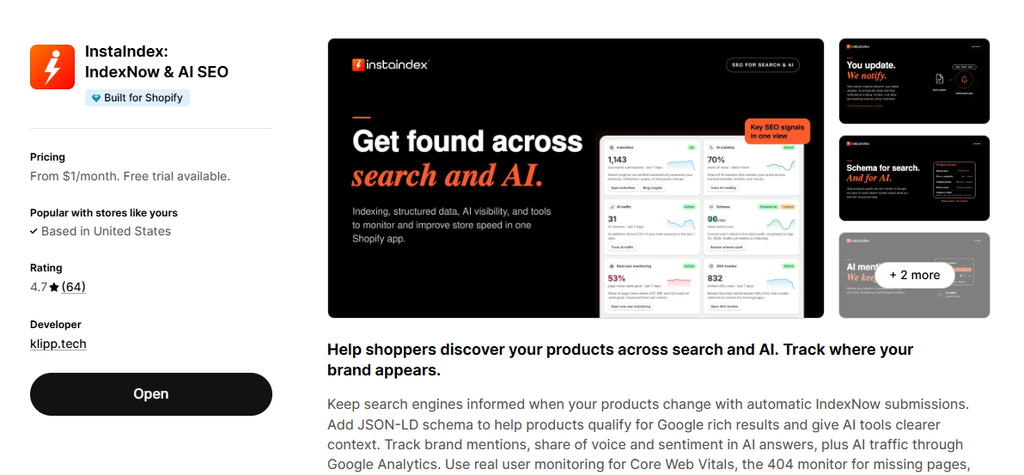
At this point, you may think that managing all this requires complicated manual work and time. Because manually checking schema, monitoring changes, watching indexing signals, and checking AI visibility across all those pages is not really an easy task.
That’s why automation becomes valuable.
And the InstaIndex SEO tool can be one of your choices as well as one that automates your crucial tasks. Here is how it helps:
- Schema Markup
InstaIndex helps Shopify merchants set up and monitor structured data, making important store information easier for supported search systems to interpret. - IndexNow Submissions
Automatically notify participating search engines and AI platforms when relevant pages change. - AI visibility monitoring
InstaIndex provides insight into how your store appears across AI search results. - Real-User Monitoring
SEO isn’t just about crawlers; your real customers matter too. So, with InstaIndex, you can get insight into how your store performs for real visitors rather than relying only on controlled tests.
Basically, InstaIndex is an all-in-one solution for Shopify store owner, helping them manage their SEO tasks easily. They don’t need to juggle between multiple SEO tools.
Conclusion
At last, you must understand one thing: AI search isn’t a miracle where you just have to put a formula, and your product starts to get in AI results. Your Shopify store still needs a strong foundation that includes clear product information, accurate schema, strong internal linking, quality content, and healthy technical SEO.
The changing part isn’t the SEO; it is how people discover information.
Users do not type long or complex keywords into traditional search boxes to get the results they want; instead, they prefer using AI platforms to receive personalized answers, complete with comparisons and suggestions, helping them make informed decisions.
So, you need to think beyond ranking and start thinking about how AI systems can find your store.
This is where the smart AI Shopify SEO tool like InstaIndex helps. It eliminates manual management and allows you to automate and monitor several important parts of the process in one dashboard, and build a stronger foundation for discovery across traditional and AI-powered search experiences.
FAQs
- Why is my Shopify store not appearing in AI search results?
Your store may not appear in AI search results for several reasons, including blocked crawlers, missing or inaccurate schema, inconsistent product information, outdated content, weak product descriptions, or technical SEO issues. - Does Shopify SEO affect AI search visibility?
Yes. Many Shopify SEO fundamentals also support AI search visibility. Clear content, strong internal linking, accurate structured data, accessible pages, and healthy technical SEO can make your store easier for AI systems to understand.
- How does schema help my Shopify store appear in AI search?
Schema gives AI systems structured information about your products, such as their name, price, availability, reviews, ratings, and specifications. This can make your product information easier to interpret accurately.
- Can blocked crawlers prevent AI platforms from understanding my Shopify store?
Yes. If relevant AI crawlers cannot access important public pages, they may have difficulty reading and understanding your store’s information. However, you should review crawler access carefully rather than allowing every crawler automatically.
- Why is accurate product information important for AI search visibility?
AI systems need reliable information to understand and describe your products. If your product page, structured data, or other store information contains conflicting prices, availability, or product details, it can create confusion and lead to inaccurate results.
- Can IndexNow improve my Shopify store’s AI visibility?
IndexNow can notify participating search engines and supported services when relevant pages on your store are updated. However, it does not guarantee faster indexing, higher rankings, or placement in AI-generated results. It is one part of a broader SEO and AI visibility strategy.
- How can I make my Shopify product pages more AI-friendly?
Keep your product information clear, detailed, accurate, and consistent. Include important details such as product name, description, price, availability, variants, specifications, and reviews, and use appropriate structured data to provide additional context.
- How can InstaIndex help with Shopify AI SEO?
InstaIndex helps automate several tasks related to Shopify SEO and AI visibility, including schema management, IndexNow submissions, AI visibility monitoring, and real-user monitoring. This can reduce the amount of manual work merchants need to handle across their stores.
- Does InstaIndex guarantee that my Shopify store will appear in AI search results?
No. InstaIndex can help improve the technical foundation and monitoring around AI visibility, but no SEO tool can guarantee that an AI platform will mention or recommend your store. Content quality, accessibility, structured data, technical SEO, and other factors still matter.
- What should I focus on first to improve my Shopify AI search visibility?
Start with the basics: make important pages accessible, fix technical SEO issues, keep product information accurate, maintain valid schema, strengthen internal linking, keep your store updated, and create helpful content that directly answers customer questions.
Leave a Reply